
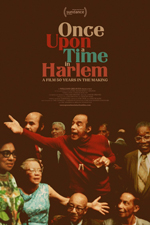
(Photo Credit: Neon)
 1/2
(“Once Upon a Time in Harlem” trailer courtesy of Neon)
The new documentary “Once Upon a Time in Harlem,” filmed on a Sunday in August 1972, tells a magical story.
But this magical story is all fact, not fantasy.
That statement is a double entendre because of the plight of African-Americans during the 1920s.
During a glorious period in a neighborhood synonymous with Black excellence, Black creatives produced some of the best art America has ever seen.
However, they did so at a time when mainstream America refused to recognize the greatness of African American artists, singers, musicians, dancers, actors, and political activists.
One of the great things about 21st-century technology is that if people want their stories to live in perpetuity, it is not that difficult to preserve their tales.
Social media journalists and Internet platforms like “Vlad TV” and “The Art of Dialogue” have dedicated many hours of time to helping the founding fathers of hip-hop tell their stories, which was not always possible during their heyday.
In the African American community, unfortunately, many important historical facts have been lost to the grave for various reasons.
Recent stories about African-American excellence probably will not be lost to the dustbin of history because many people have a camcorder (i.e., a smartphone) on them always.
But back in the early-to-late 20th century, it took effort to document history.
Therefore, when William Greaves was able to assemble Harlem Renaissance luminaries at Duke Ellington’s home for a cocktail party, he brought to life heroes of African-American history for future generations who only knew them as figures in a literature or history book, not necessarily as real people whose lives were just as real as everyone else’s.
But with “Once Upon a Time in Harlem,” it becomes apparent that the talent and leadership of the 1920s were not much different than their heirs one century later.
A century later, many African-American creatives are using their talents to be a voice for their community, even though mainstream America still tries to silence them like it did their predecessors of the Harlem Renaissance.
Over 100 years later, African-American social, political, religious and community leaders are still debating how best to move the African-American community forward, just as the leaders of the Harlem Renaissance did in the 1920s and during the filming of “Once Upon a Time in Harlem” in the early 1970s.
But what the cast in “Once Upon a Time in Harlem” do not have, that the current generation benefits from, is social media.
With platforms like Facebook and Instagram, it is almost impossible to lose contact with friends, former classmates or former colleagues.
But in the 20th century, when a person moved away or moved on, a person only found out about them via word of mouth.
And if they crossed paths, it was often by chance.
Therefore, when people walk into Ellington’s home on that Sunday in 1972, it almost feels like a class or family reunion.
In “Once Upon a Time in Harlem,” it seems like every relative or classmate who is on this side of Heaven shows up to reminisce about the good ol’ days of the Harlem Renaissance.
One by one, they all walk into Ellington’s home.
Harlem Renaissance icons like pianist Eubie Blake, artist Romare Bearden, poet Arna Bontemps, historian John Henrik Clarke and writer George Schuyler all pick up where they left off, as if 50 years had not passed since they made a permanent mark on African-American history.
Although many of the artists, historians and activists present are men, the women of “Once Upon a Time in Harlem” make sure they are heard, whether speaking up for their husbands or speaking up for the queens of the Harlem Renaissance like Zora Neale Hurston.
The conversations in “Once Upon a Time in Harlem” make one imagine what the discussions were like during the Civil Rights Movement of the 1950s and 1960s.
Although many of the men, like Rev. Martin Luther King, Jr. and Rev. Ralph Abernathy, received the spotlight from the press, many women of the movement did a lot of the heavy lifting.
In “Once Upon a Time in Harlem,” Countee Cullen’s widow Ida Mae Cullen makes sure that the group of luminaries does not forget the contributions that her late husband made to the Harlem Renaissance.
And in that regard, Ida Mae becomes a microcosm of the entire Harlem Renaissance movement, the documentary “Once Upon a Time in Harlem,” and subsequent African-American movements.
Ida Mae’s outspokenness and being unapologetic about it are always necessary to keep the concerns and the plight of the African-American community in the mainstream.
If people are not willing to speak up, despite what others might think, nothing will change for the African-American community or other marginalized groups.
Unfortunately, some of “Once Upon a Time in Harlem” drags, as is often the case with senior conversations.
But the sharpness that some of the participants have, even as some creep towards 100 years old, is remarkable.
Many can still recite the poetry of others or their own lines from plays.
But to see a time capsule of an era, as if audiences are in the room with the cast members, is a wonderful addition to African-American history.
However, directors David Greaves, Liani Greaves and Williams Greaves should have included information about what happened to the participants in the years following the filming in 1972.
Doing personal research will let viewers know what happened to some of the participants shortly after the filming, which should serve as a reminder to preserve the history of heroes and capture it while they are still in the land of the living.
REGAL RATINGS
FOUR CROWNS=EXCELLENT
THREE CROWNS=GOOD
TWO CROWNS=AVERAGE
ONE CROWN=POOR

- Movie Review: ‘731’ Another Film That is a Warning - September 26, 2025
