
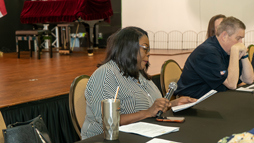
Journalist Nakia Cooper moderates the Houston Community Media on hurricane preparedness (Photo Credit: Jon Guevara of Our Voces/Latin Touch Media).
Houstonians should distinguish between Hurricane preparedness and hurricane panic.
However, who could blame Houstonians in 2006 for panicking after seeing Hurricane Katrina destroy their neighbors in New Orleans in 2005?
Therefore, when Hurricane Rita hit the Greater Houston area, panic hit like an atomic bomb.
Highways became parking lots.
Houstonians slept at gas stations along I-45.
A trip to Dallas that would normally take around four hours took many over 24 hours.
Desperate people relieved themselves in public along roads because they didn’t have any choice.
And at the end of the day, Hurricane Rita did very little damage to Space City.
Houston Community Media, a collective of local communications executives, held a briefing on July 22 where disaster relief experts shared tips on how to stay 10 steps ahead of the next devastating storm.
Moderator Nakia Cooper said, “The truth is, preparedness doesn’t begin (when) a storm enters the Gulf. Preparedness begins at home. It begins with knowing your local resources, having a family emergency plan, staying informed through trusted sources, and building stronger communities long before the disaster strikes. Now, our goal today is simply to help every Houston family and beyond understand where to turn, who to trust, and how to prepare locally before the next emergency.”
Bryan Murray, deputy director and public information officer for the Harris County Office of Homeland Security and Emergency Management, said preparedness is not something that a person or family should do only during hurricane season.
Murray said in Houston, severe weather occurs 12 months out of the year.
Therefore, disaster preparedness should last all year long.
He said that a home’s insurance policy could make a world of difference during a disaster like the derecho in May 2024.
Murray advises people to review their insurance policy because paying a few more dollars could give someone the best possible coverage.
He said that people should understand what a deductible means.
Murray said, “Your deductible is most of the time your percentage of the value of your property. So let’s say you own an average house in Houston of almost $300,000. Let’s say you have a three percent deductible.
“That’s $9,000 that you’re going to be out of pocket on those repairs. So keep in mind this is money you’re going to have to come up with. If you live anywhere in a floodplain, flood insurance is a must. Traditionally, we have sent people to FEMA because FEMA is the national flood insurance policy provider. It’s been, for most people, the best way to get flood insurance…
“I have private flood insurance. FEMA caps their house damage at $250,000. That would not cover my house contents; FEMA would not cover the contents of my house. And I don’t live in a mansion. Don’t get the wrong idea. But when I went to the private market, I was able to find a company that actually built up to $2.5 million in property value.”
While people living in a floodplain must purchase flood insurance, private insurance could provide millions of dollars of coverage.
On the other hand, FEMA caps coverage at $250,000.
Unfortunately, solar panels are not necessarily covered by insurance.
Therefore, Murray implores Houstonians to spend time with insurance agents and educate themselves about the insurance they have and the insurance that they could have.
Cooper said, “I found out through my carrier, even though I had about $35,000 worth of damage to my home, that $1,500 cap on what they would give me.
“And they said the difference was the way that I had the insurance package that I purchased, and my insurance package was for like what they would, what we would usually have out here. And they said it was a $7 difference monthly for my upgrade. That would have helped me. And I remember the man coming by to do the damage assessments.
“And he says, I’m going to tell you now. I look around, he said, but you’re going to be capped at $1,500 because of what…your package is…I was devastated, but the good thing was I went and got an SBA loan or whatever, and that helped me out. But those were some things that I didn’t know about, you know?”
Besides insurance, Houstonians can do several things to make sure that they are prepared for the next storm.
Houstonians should have backup power and all electronics charged up before the storm.
Throughout the year, buy nonperishable food items and water so that when a storm comes, a lack of supply and a lack of funds will not adversely affect them as much.
Instead of buying one can of green beans while shopping, buy two and hold on to the extra can.
Having a battery-operated radio will prove handy if Houstonians lose power because the radio will allow them to keep up with the news even if electricity is out.
Businesses can reach out for help via the website: beforeduringafter.com.
All Houstonians can use 211 for basic needs.
Houstonians must give 211 their zip code because vulnerable zip codes will receive assistance first.
The number 311 is for government services.
Residents of the Greater Houston area can download preparedness guides in 11 languages at unitedwayhouston.org.
For further assistance and information, Houstonians can reach out to readyharris.org.
But the key word during a natural disaster should be assistance, whether it is from governmental agencies, nonprofit organizations or regular citizens trying to lend a helping hand.
One of the good things that comes from natural disasters is the natural reaction of humanity.
People tend to go the extra mile for their neighbors, near and far, during natural disasters.
Therefore, Houstonians must always be prepared to lend a helping hand, even when disasters avoid us and those close to us.

- Movie Review: ‘731’ Another Film That is a Warning - September 26, 2025
