
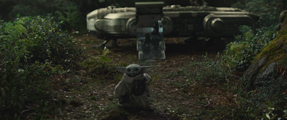
David Acord creates the sound and voice for Grogu (Photo Credit: Walt Disney Pictures).

(“Star Wars: The Mandalorian and Grogu” trailer courtesy of Star Wars, Lucasfilm and Disney).
The definition of a “G” or gangsta is someone who is ride or die for their homies or family members.
A real “G” throws caution to the wind when it is time to pull up on the opps, even if the opps have the upper hand.
In the dope movie “Star Wars: The Mandalorian and Grogu,” the diminutive co-star of the flick defines what a gangsta is and proves that the smallest geez sometimes come in the smallest packages.
In “Star Wars: The Mandalorian and Grogu,” the New Republic has ushered in a new day for the universe.
The galaxy is no longer controlled by the oppressive Empire.
However, the Empire still has some remaining remnants, and some who believe there was more law and order when the Empire ruled the world.
To maintain the new status quo for the New Republic and keep the Empire as dormant as possible, Colonel Ward (Sigourney Weaver) often employs the skills of the bounty hunter, The Mandalorian (Pedro Pascal), who always has his tiny, but trusted, companion Grogu by his side.
The only problem that Colonel Ward has with Mando is that his missions are often messy and destructive.
She would rather him capture his opps and bring them in alive so that she can get information on the Empire and other adversaries.
But for some strange reason, Mando’s missions often end up turning violent, which makes for some “fire” fighting scenes, especially at the beginning of “Star Wars: The Mandalorian and Grogu.”
To Mando’s defense, why wouldn’t a person fight if they had his skillset?
When a mission is complete, Colonel Ward simply gives Mando his next target.
Unfortunately, for the New Republic, no one knows what the next opponent looks like.
Colonel Ward only knows his name.
To find out more about his next opp, Mando visits the Huts, the biggest thugs on the planet, formerly led by Jabba the Hutt.
In “Star Wars: The Mandalorian and Grogu,” the leaders of the Huts, the twins, have their own mission for Mando.
They need him to rescue their nephew, whom they have not seen in the longest time, and bring him home, where he belongs.
Without spoiling too much of “Star Wars: The Mandalorian and Grogu,” the movie does touch on some very real-world situations.
One of those situations is oppression and the elimination of the oppressor.
It is hard to change a way of life, even after a revolution.
That is why there are still some remnants of the Empire prevalent in “Star Wars: The Mandalorian and Grogu.”
Even if revolutionaries overthrow an oppressive regime, there are often people who remain loyal to the oppressor, even after the former oppressor has lost all power.
That is so because oppression often benefits a large portion of society, even if it ruins everyone else’s life.
Because of that, those on the side of justice must remain in the good fight and never rest on their laurels.
It is when people get complacent that atrocities happen.
Another real-world situation addressed in “Star Wars: The Mandalorian and Grogu” is the difference between generations, and why children should not be judged for the sins of their fathers or mothers.
People often say that the apple does not fall too far from the tree, forgetting that just because it falls in a certain place does not mean that it must stay there.
Some children attempt to totally distance themselves from the sins of their parents.
And some children are the polar opposites of their parents without even trying.
Therefore, people should not be judged solely on the basis of their family or geographic ties.
But with all the heavy situations that “Star Wars: The Mandalorian and Grogu” touches on, the biggest message is one of friendship and family bonds.
The real message is about love, loyalty and fidelity.
And Grogu exhibits all those characteristics and more when it comes to his dedication to the Mandalorian (Pascal, “Eddington”).
But while Grogu shows what loyalty is really about, Rotta the Hut (voiced by Jeremy Allen White, “Springsteen: Deliver Me for Nowhere”) shows how blind loyalty can ruin someone if they are not careful.
Loyalty is a wonderful trait to have if it is directed at someone who deserves it and reciprocated.
But if someone is loyal to the wrong person, group or thing, it can cause more harm than one can imagine.
Nevertheless, the character Rotta the Hut is unique because it shows the difficulty that a child can have when he is trying to get out of the shadow of their larger-than-life parent.
When someone comes from a famous or infamous parent, it becomes almost impossible to forge one’s own identity because people will often compare that person to their parents, for better or worse.
But “Star Wars: The Mandalorian and Grogu,” proves that just because someone comes from a particular bloodline does not mean actions and behavior are in the bloodstream.
It is all about choices.
And a person makes their own choices.
Those choices are not made by the past actions of family members or members of the same community.
Unfortunately, “Star Wars: The Mandalorian and Grogu” has some corny elements.
But the “dopeness” makes up for the corniness.
And the “dopest” thing about the movie is Grogu, a true “G.”
REGAL RATINGS
FOUR CROWNS=EXCELLENT
THREE CROWNS=GOOD
TWO CROWNS=AVERAGE
ONE CROWN=POOR

- Movie Review: ‘731’ Another Film That is a Warning - September 26, 2025
