
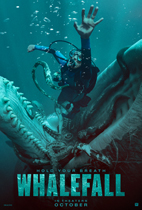
(Photo Credit: 20th Century Studios)

(“Whalefall” trailer courtesy of 20th Century Studios)
What is the perfect way to lose a parent?
Is it them lasting as long as God desires?
Or is it them going out on their own terms doing what they love.
Unfortunately, there is no easy answer to that question.
But the real question is what life lessons does a child take with them when their parents are no longer with them, and how does that improve their chances of survival in this cruel and harsh world?
As one might expect, “Whalefall” begins on a boat in a large body of water.
But this expedition is not one of the joyful natures.
This trip is a somber and sad one, even though it looks like the typical fishing trip at the onset.
In “Whalefall,” Mitt Gardiner (Josh Brolin, “Dune: Part Two”) is struggling with a vicious cough, while his boat mate (John Ortiz, “Ad Astra”) ignores his hacking while concentrating on fishing.
Mitt puts on some swim gear.
He fastens himself to some levers, as his boat mate begins to cry.
Then he descends into the ocean one final time.
“Whalefall” then picks up a year, to the day, later as Mitt’s survivors gather to pay homage to their lost but beloved patriarch.
Although Mitt has three children, two girls and one boy, he treated them differently as one would expect of a father.
While his daughters might have loving memories of their departed father, Jay Gardiner (Austin Abrams, “Weapons”) has different memories of their father.
Jay remembers his father as being domineering, controlling and not very loving.
When Jay wants to hang with his friends to celebrate their brother, Mitt takes offense that Jay would rather go to an amusement park called Oceanworld, rather than going into the real ocean with his father.
Throughout Jay’s childhood, Mitt has blasted him for not taking the water and scuba diving seriously, seeing his lessons of preparation for the ocean as life and death, especially dealing with the large creatures of the sea.
Little things like understanding the three methods of obtaining oxygen whole underwater could mean the ocean being a person’s final resting place versus returning home to the comforts of one’s own bed on land.
No matter what Jay accomplishes, like a college scholarship to a school in Iowa, seems to please his father.
Even Jay’s attempts to bond with his old man ends with him jumping from a boat and swimming back to land.
A year after Mitt’s passing, his sisters seem to be in a much better mental state than Jay.
Mitt left all three of them letters before he died.
But Jay is the only one who has yet to open and read Mitt’s final thoughts.
Despite his feelings for his father, Jay still loves him and misses him.
It bothers him that his father has an empty casket at the cemetery.
He even refuses to get out of the car when his mother visits Mitt’s grave.
Therefore, while his family members are sharing memories of Mitt, Jay is secretly plotting a mission to retrieve Mitt’s body from the ocean, even though he hates diving and law enforcement has prohibited people from entering the water on the day of his planned underwater escapade.
But nothing can stop a mourning son from getting the type of closure he wants for his father, even if that means encountering a monstrous whale who swallows Jay whole and closes his mouth, seemingly for good.
What should Jay do, assuming the whale does not fully digest him?
Should he panic?
Or should he remember and utilize the life lessons that his father instilled in him, even though at the top he thought his father’s lessons were preposterous for a person who did not love diving like his father did?
The decision that Jay chooses to make could mean the difference between returning to his surviving family members or joining his father in the ocean for eternity.
“Whalefall” mirrors the biblical story of Jonah being swallowed by a whale in several ways.
First off, their names are similar.
Jay could be short for Jonah for all intents and purposes.
Secondly, a giant fish swallows both men.
Thirdly, Jonah and Jay most rely on something outside of the natural world to free them from the belly of the best, literally.
While Jonah relied on faith and his believe in God and God’s Word, Jay relies on the lessons taught by his father to survive.
In that way, the teachings of the Bible and the teachings of one’s parents, often serve similar purposes.
Even for nonbelievers, the lessons of guidance taught by one’s parents might not make sense during childhood.
But when times get rough, adults often find themselves using those childhood lessons to make it through the trials and tribulations of life.
The Bible is also used for guidance when life has someone’s feet to the fire.
The biblical lessons might sound foolish when everything is smooth like gravy.
But when life gets lumpy and bumpy, people often lean back on the lessons provided by God.
Morals and lessons notwithstanding, “Whalefall” is a pretty dope movie, especially because of the visuals.
The visuals in “Whalefall” go from the beauty of nature to the nastiness of a whale’s insides.
The only major downfall of “Whalefall” is the ending is basically predictable.
But what is also predictable are the hardships of life.
And although many people no longer have their parents or mentors, their lessons life on forever and could mean the difference between life or death.
REGAL RATINGS
FOUR CROWNS=EXCELLENT
THREE CROWNS=GOOD
TWO CROWNS=AVERAGE
ONE CROWN=POOR

- Movie Review: ‘731’ Another Film That is a Warning - September 26, 2025
