
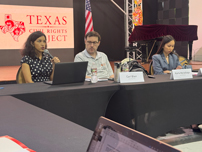
Karla Maradiaga, Carl Blair and Nina Olshi (L-R) give presentations at Houston Community Media’s briefing entitled “Reporting on the Primaries and Midterms—What Audiences Need to Know” on Feb. 19 (Photo Credit/Regal Media Group/Todd A. Smith)
Who can vote in an American election?
What district does a family live in?
What if a person’s gender identity does not match the gender on their driver’s license?
Do states run elections, or does President Donald Trump’s administration and/or his Republican Party run elections nationally?
Those are just a few of the questions heading into the 2026 midterm elections.
On Feb. 19, Houston Community Media hosted a media briefing for local journalists entitled “Reporting on the Primaries and Midterms—What Audiences Need to Know.”
The media briefing held at the Southern News Group, included speakers like Carl Blair (Senior Election Protection Attorney at the Texas Civil Rights Project), Karla Maradiaga (Voting Rights Staff Attorney at the Texas Civil Rights Project), Nina Olshi (Voting Rights Staff Attorney at the Texas Civil Rights Project) and La’Dereka Christian (Voting Rights Outreach Coordinator at the Texas Civil Rights Project), who participated in the briefing via a prerecorded message.
Unfortunately, some Texas voters might get scared off because of perceived threats like Steve Bannon claiming that I.C.E. officers will patrol the polls to make sure that undocumented immigrants do not cast a vote.
Some voters have reported difficulty voting when they appear at early voting polls, like election workers having difficulty finding their names in the database.
However, if Texans find any suspicious behavior at the polls, they can let their concerns be heard by calling Election Protection Hotlines.
The hotlines are designed to help people who speak various languages.
The Election Protection Hotline for English speakers is 866-OUR-VOTE.
Spanish speakers are encouraged to call 888-VE-Y-VOTA.
For those speaking Asian languages, the Election Protection Hotline number is 888-API-VOTE.
Those speaking Arabic should call 844-YALLA-US.
And for those wanting to report disability rights issues, call 888-796-VOTE.
The last day to vote early is Feb. 27.
Texas voters in Harris, Fort Bend, Galveston, Brazoria, Chambers, Liberty and Austin Counties can vote at any precinct in their county.
However, voters in Montgomery and Waller Counties must vote at their assigned voting location.
Election day is March 3.
March 3 is the last day for a county to receive mail-in ballots.
And March 9 is the last day for mail-in-ballot curing and providing identification for provisional ballots.
Ballot curing is correcting any incorrect information on a mail-in ballot, like forgetting to sign, forgetting to include a social security number or driver’s license number, etc.
Acceptable forms of identification include a Texas Driver’s License, Texas Election ID Certificate, Texas Personal ID Card, Texas Handgun License, U.S. Military ID card with a photograph, U.S. Citizenship Certificate with a photograph, or a U.S. Passport (book or card).
Voters need to know that the ID requirement is to verify identity, not residence.
Just because a person has a different address on their ID than they do on their voter registration card does not mean they cannot use that ID.
If a voter is over the age of 70, they can use an expired ID to vote, no matter how long the ID has been expired.
For voters under the age of 70, they can use an expired ID if the ID has been expired no more than four years.
This is important for disabled and elderly voters who no longer drive or cannot leave the house to obtain a new ID.
Only American citizens can vote in the 2026 midterm election.
Potential voters must be 18-years-old on the date of the election.
A citizen must not be currently serving a sentence for being convicted of a felony.
If a citizen has a guardian and a judge said that the citizen cannot vote, then that person under guardianship cannot vote.
Lastly, a citizen must be registered to vote.
Feb. 2 was the last day to register for the March 3 midterm primary election.
Voting by mail has faced scrutiny from President Trump because he believes it leads to cheating.
However, Trump has voted by mail in the past.
Nevertheless, Texas has rules on who can and cannot vote by mail.
People who can cast a ballot by mail include those going away from their county during the early voting time period or on election day, people who are sick or have a disability preventing them from voting safely in person, people 65-years-old or older on election day, people in jail but still eligible to vote and those expecting to give birth within three weeks before or after election say.
Voters can receive assistance while voting, in person or by mail.
Voters can receive help from a family member, friend or poll worker.
Texas does not have age restrictions on who can receive assistance while voting.
However, the voter cannot receive help from their boss or union representative.
The helper can go into the voting booth with the voter that they are helping.
All polling locations must be accessible for disabled voters, with things such as accessible voting booths.
Voters with mobility issues can be moved to the front of the line by poll workers.
No poll worker can question whether someone is truly disabled to receive disability accessibility.
However, if a person wishes to vote curbside, they must sign a form under penalty of perjury saying that they cannot safely vote inside.
Voters should watch out for poll watcher misconduct, blocking polling place entrances, polls opening late or closing early, language or disability access issues, lack of signage about curbside voting, spreading misleading or false information or discouraging, intimidating or threatening voters or potential voters.

- Movie Review: ‘731’ Another Film That is a Warning - September 26, 2025
