
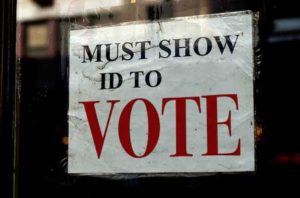
Early voting in Texas begins Oct. 19.
It’s beginning to look a lot like Christmas election season.
Unfortunately, the last day to register to vote has passed.
But several important dates remain, like early voting beginning on Monday Oct. 19, and RegalMag.com wants to make sure that the entire Texas chapter of the Regal Court is ready and able to cast their votes in the 2026 midterm election, which take place on Tues. Nov. 3.
As a matter of fact, it is not beginning to look like election season.
It is already election season because many voters have already mailed in their ballots prior to early voting starting.
RegalMag.com would like to thank for participating in the political process.
But for those who have not yet participated, or remain on the fence about voting this fall, this information is especially for you.
In Texas, early voting will last until Oct. 30.
Friday, Oct. 23 is the final day for voters to correct defective mail-in ballot applications.
Nov. 3 at 7:00 pm central time is the deadline for the county to receive mail-in ballots if the envelope is not postmarked.
Wednesday, Nov. 4 is the last day for the County to receive mail-in ballots if the envelopes are post marked.
The only exceptions to that Nov. 4 deadline are if a voter is overseas or is a military voter.
Monday, Nov. 9 is the last day for in-person ballot curing and providing identification for provisional ballots.
The issue of non-citizens voting in United States elections is a hot-button issue.
Therefore, who is officially able to vote in American elections?
A person does need to be a citizen of the United States.
They must be 18 years old on election day.
A person can vote if they are not currently serving a sentence for a final felony.
Carl Blair, an attorney with the Texas Civil Rights Project, told RegalMag.com, “A final felony conviction is a guilty plea, a conviction that isn’t being appealed, a plea of no contest.
“A conviction that is in the middle of being appealed is not a final conviction for voting rights purposes in Texas.”
Even more controversy has erupted over whether voters will be intimidated by ICE agents and other law enforcement officials while at the polls.
While that remains to be seen, there will be poll monitors, poll workers and poll watchers when people arrive at the polls to cast their ballot in October and early November.
The three positions have distinct job descriptions.
Poll monitors and legal monitors are non-partisan volunteers who stand past the 100-foot markers at polling places and offer assistance to voters with questions and look out for, and report, issues that are visible outside of polling locations (i.e.—long lines and late openings or early closings).
Secondly, poll workers, also known as election officers or election workers, are individuals who actually administer the election inside of polling locations. This category consists of election judges and election clerks.
Lastly, poll watchers are people who are affiliated with a political party, candidate or proposition on the ballot who have a legal right to observe election activities inside of polling locations.
While some people, other than voters, are allowed inside of the polls, while voters are casting their vote, the entire public is entitled to voter registration information from the Texas secretary of state and every county registrar via a public information request.
A statewide form can be found at the secretary of state’s website.
Available information includes a voter’s name, registration number, birthdate and address.
However, that information must be used for non-commercial purposes.
Despite much voter information being public, some people can keep their information private, while maintaining their voting status via the Address Confidentiality Program (ACP).
Survivors of family violence, sexual assault or abuse, stalking, child abduction or human trafficking.
The person applying for this program must have a protective order or temporary injunction in place or provide documentation of the crime.
For those who qualify, a substitute post office box will be provided and mail forwarding service.
To apply, voters should apply via the Attorney General’s website or call the ACP at (888) 832-2322.
Another controversial issue hitting the news this election cycle in The Lone Star State is the voter suspense list.
Being on the suspense list does not cancel a voter’s registration unless they fail to respond to the confirmation notice and do not vote in the next two federal election after being put on the suspense list.
In 2022, approximately 1.2 million Texas voters were on the suspense list.
In 2024, approximately 2.1 million Texas voters were on the suspense list.
And in 2026, approximately 1.2 million Texas voters are on the suspense list.
Furthermore, in Texas, voter registration is handled by the voter registrar for each county, and counties have a legal obligation to perform ongoing voter roll maintenance.
The suspense list is just one part of the maintenance process.
Sometimes, a person gets on the suspense list of the registrar has reason to believe that a voter’s current residence is different than the address on their voter registration card.
Those who find themselves on the suspense list can update their information now or complete a statement of residence when they vote whether they have the same address and same county or different address and the same county.
However, those living in a different county must try to vote early if they have missed the voter registration deadline (Oct. 5) to register in their new county.

- Movie Review: ‘731’ Another Film That is a Warning - September 26, 2025
