
Victor Glover joins a growing list of Black astronauts to make their way to the Great Beyond.
Contrary to the sketch comedy show “In Living Color,” Slick Johnson was not the first Black man on the moon.
Thankfully, that also means that Buzz Aldrin, Neil Armstrong and the crew did not leave ole Slick on the moon like depicted on the classic Fox show.
Thirty-six years after the Slick Johnson bit, Victor Glover will become the first Black man to travel to the moon via the Artemis II.
On April 1, Bolarinwa Oladeji of The Grio reported, “Glover, a South California native, will serve as pilot on the Artemis II mission, which is scheduled to send astronauts around the Moon and back to Earth. While the mission will not land on the lunar surface, it is expected to mark the first time a Black astronaut travels to the Moon.
“The Artemis II mission is part of NASA’s broader Artemis program, which aims to return humans to the Moon for the first time since the Apollo 17 mission in 1972.
“Glover, 49, previously made history in 2020 when he became the first Black astronaut to serve on a long-duration mission aboard the International Space Station. His upcoming role continues that trajectory, though he has often emphasized teamwork over personal milestones.”
Although Glover recognizes the significance of history-making accomplishment, he is quick to pay homage to past Black heroes who laid the groundwork for his moment.
Glover pointed out Livingston Holder, a former Air Force engineer and payload specialist, as someone who made a huge impact on his career trajectory.
Artemis II will also make history for having the first woman, Christina Koch, to travel to the Moon and Jeremy Hansen, who will become the first non-American astronaut to travel to the Moon.
Oladeji added, “Born in Pomona, California, Glover’s path to NASA included a distinguished career in the U.S. Navy, where he logged more than 3,5000 flight hours across over 40 aircraft and flew numerous combat missions. He was selected as a NASA astronaut in 2013 after being chosen from thousands of applicants…
“If successful, Artemis II will mark a major step toward NASA’s long-term goal of establishing a sustained human presence on the Moon and eventually preparing for missions to Mars.”
According to the National Museum of African American History & Culture (NMAAHC) website, “Commander Glover recently piloted the first operational flight of the SpaceX Crew Dragon to the International Space Station (ISS), a trip that broke the record for the longest human spaceflight by an American crew.
“Whereas over 350 NASA astronauts have traveled into space, Commander Glover currently stands as one of only 15 African Americans who have made the historic trip. Prior to joining NASA, he flew more than 3,000 flight hours in more than 40 different aircraft, including combat missions during Operation Iraqi Freedom, and contributed to the indelible legacy of African American astronauts when he became part of the 21st NASA astronaut class of 2013.”
Glover joins a growing list of Black astronauts to make their way to the Great Beyond.
In 1983, Guion “Guy” Bluford, Jr. broke the color barrier for astronauts, flying on STS-8 and completing 688 hours in space over four missions.
Unfortunately, the second Black man in space (1984), Ronald McNair, died tragically when the space shuttle Challenger exploded on live television in 1986.
Many schoolchildren at the time watched the tragedy on television in their classrooms across America.
In Houston, Rockets All-Star Ralph Sampson spoke about the explosion, offering words of comfort to fans gathered at The Summit for the NBA basketball game.
A year earlier, in 1985, Frederick D. Gregory became the first Black man to pilot and later command a space mission.
Mae Jemison made history in 1992 by becoming the first Black woman in space, serving as a mission specialist for the space shuttle Endeavor.
Jemison’s history-making achievement was chronicled in the Black press, appearing on the cover of Jet magazine.
In 1995, Houstonian and member of Kappa Alpha Psi Fraternity, Inc., Bernard Harris became the first Black American to walk in space.
The National Museum of African American History & Culture website added, “Commander Glover made history as the first-ever Black astronaut to live on the ISS as part of a long-duration mission. The NMAAHC, in partnership with the Smithsonian’s National Air and Space Museum, documented Glover’s historic journey. We also helped him connect with those on the ground who were curious about scientific experiments, space walks, weather studies, and other research that contributes to our understanding of our planet and universe—from a vantage point that very few will ever reach.”
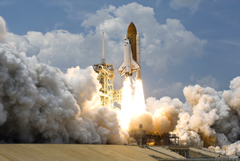
On the afternoon of April 1, Artemis II launched into outer space, with four astronauts on board.
Unfortunately, Artemis II has endured some hiccups.
Nadia Drake of The Scientific American wrote, “The mission debuts more than three years after the uncrewed Artemis I flight, and it has had a similarly rocky path to the pad. Much like its predecessor, Artemis II ultimately launched months after missing its initial February window, set back by propellant leaks and other issues with the ground systems and the SLS—a rocket, built in part from vintage space-shuttle-era hardware, that’s now extremely overbudget. Amid those delays, NASA leaders revamped much of the Artemis program, although the Artemis II mission is unchanged. The program architecture now includes another crewed flight in the sequence, and increased cadence of missions to the moon and, in the future, a decreased reliance on the budget-busting and finicky SLS to get there.”
