
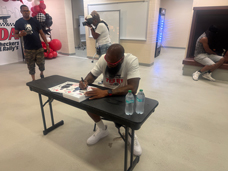
Slim Thug signs autographs for fans for 713 Day in Houston in 2025 (Photo Credit: Regal Media Group/Todd A. Smith).
Hip-hop stars often represent their old neighborhood.
But like many other affluent African-Americans, once they make it big, they move to the suburbs.
While there is nothing wrong with upward mobility, many African-Americans are quick to abandon family property that has been in the family for generations, prematurely.
And then non-African-Americans come in, buy the land for cheap, “revitalize” the neighborhood, which raises the property value, forcing many longtime residents to leave their homes because they can no longer afford the property taxes.
Atlanta rap star Lil Baby, 31, is an exception to that rule.
While he probably has an estate in the suburbs or the country, away from the hustle and bustle of the inner city, he is not sitting idly as gentrification changes many historic African-American neighborhoods throughout the country.
He is buying up property in his old neighborhood to prevent it from falling victim to gentrification.
Kay Wicker of The Grio reported that Lil Baby posted a YouTube video last week as he took his sons back to his old home to show them where his legendary career began.
According to Lil Baby, because people were trying to take his old hood, he bought back his old home to give to his sons, Jason and Loyal.
He described the purchase as him putting his foot down.
Wicker reported, “He pointed out surrounding homes that have been scooped up by developers and are now being remodeled. The rapper then takes his sons on a tour of the property, using his phone as a flashlight and explaining to them—even as one shows a bit of apprehension about its current state—that once it’s fixed up, it will be back in its prime. While musing about what he plans to do with the home, he said he may rent it out but has no intention of ever selling it.”
Lil Baby said, “I done did too much in, for, and around the hood.”
He said that young people are “ready to die” for a neighborhood that they do not even own property in.
The emcee who has collaborated with hip-hop heavyweights like Drake and Gunna added, “I ain’t just like, ‘Ah, it’s like a strategy to me buying a house.’ I’m buying all the houses, all the properties that I used to hustle in front of. There were times when this was abandoned, and I still was standing here while it was abandoned. No light, no water, no nothing—just me and smokers. These be like my investments, but they’re also more sentimental value pieces.”
Wicker added, “Atlanta has routinely ranked among the fastest-gentrifying cities in the country, making the rapper’s move feel especially timely. Born Dominique Armani Jones, the artist was raised in Atlanta’s Oakland City neighborhood and has remained active in the community since rising to fame.
“In addition to buying homes in the area to help shape its future, he has led back-to-school drives, launched The Jones Project to support underserved families, and created a $150,000 scholarship at his former high school.”
Lil Baby said, “It means a lot to be able to come back and give back.”
The Atlanta native is not the only rapper making a difference by buying properties in their old stomping ground and giving back to the children of their hometown.
Legendary Houston rapper Slim Thug has a history of investing in real estate, as well as sponsoring back-to-school drives for the children of Houston’s north side.
Via his Boss Life Construction company, the rapper born Stayve Thomas has invested in real estate in Houston neighborhoods to stave off gentrification since 2015.
In a 2017 interview on the radio show “Sway’s Universe,” the Boss Hogg Outlawz CEO said, “We built affordable homes because a lot of people are going through these hoods and buying up everything, you know what I’m saying, and running these people out of there and building these expensive places and running them taxes up. So, you know it’s definitely going down in H-Town.”
According to the company’s website, “Boss Life Construction is dedicated to building affordable homes without sacrificing the quality that you deserve. Our business, infrastructure, and community program investments help make neighborhoods work for people of all incomes.”
Land trusts are another way that many Black and Brown communities are creating to prevent rising taxes brought on by gentrification.
Todd A. Smith of RegalMag.com reported, “Many predominantly Black and Brown communities have seen their property values increase so exorbitantly that they cannot afford to keep their homes.
“Furthermore, many of the homes in these communities have been in families for generations.
“But because descendants cannot afford rising property taxes, they find themselves losing the property, resulting in them being unhoused.
“Land trusts are a way that people can avoid this occurring, with money set aside to handle potential property value and property tax increases.
“In fact, land banks and land trusts work together to make sure that rising property values do not displace homeowners.
“Land banks activate the land, while land trusts allow for the land to remain affordable and in the hands of the community.
“Black farmers in Albany, Ga. started the land trust trend, collectively buying property so that it does not fall into the hands of people outside of the community who want to buy cheap land, build luxurious properties, which increases the taxes, and forces longtime homeowners from their land.
“Land owned by collectives prevents gentrification because property is not owned by individual citizens or individual families.
“The property is owned by the community as a whole.
“Land trusts are community-governed.
“And stewardship keeps the property taxes down and maintains affordability for the people of the community.”
